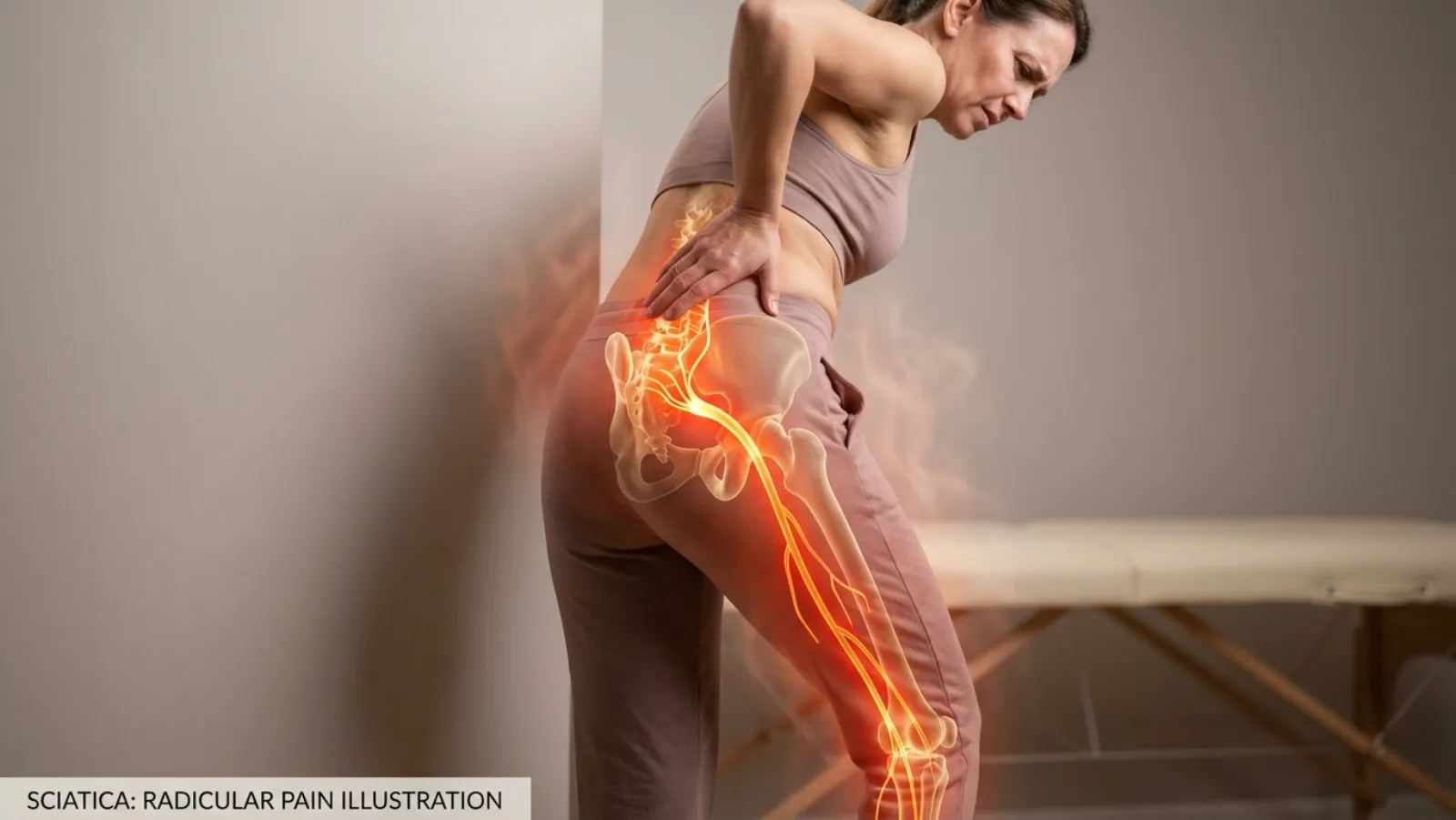
Pain that radiates from the buttock to the foot, tingling, or a burning sensation in the leg: these are classic signs of an irritated sciatic nerve. Contrary to what many people think, the solution is not to avoid movement. It is to move the right way, with specific massage and stretching.
Anatomy of the sciatic nerve
The sciatic nerve is the largest nerve in the body. It runs down through the buttock, along the back of the leg, and divides near the knee into two smaller nerves. When irritated or compressed, it causes pain anywhere along this path.
That is why the pain can be:
- In the buttock only
- In the back of the thigh
- In the shin or ankle
- Along the whole leg on one side
The 4 main causes of sciatica
1. Disc protrusion or herniation
The intervertebral disc between the L4-L5 or L5-S1 vertebrae bulges backwards, compressing the nerve root. It is one of the most common causes.
Signs: sudden pain, worse when bending forward, tingling in the legs.
2. Piriformis syndrome
The piriformis muscle (deep in the buttock) contracts and compresses the sciatic nerve that passes beneath it. It is often called "false sciatica" because it isn't the disc, it is the muscle.
Signs: deep pain in the buttock, better with rest and stretching.
3. Poor posture
Sitting a lot with crossed legs, keeping a wallet in the back pocket, or driving long distances tightens the buttock muscles and compresses the nerve.
Signs: the pain grows through the day, and eases after stretching and movement.
4. Injury or trauma
A fall, intense sport, or a badly executed heavy workout can irritate the nerve or cause micro-trauma in the neighbouring muscles.
Signs: pain starts after a specific activity, there may be bruising.
The difference between sciatica and ordinary leg pain
True sciatica (nerve root)
- One-sided pain (on one side only)
- Radiates from the back of the hip to the foot
- Tingling, numbness, or "pins and needles"
- Worse with spinal flexion (touching your toes)
- There may be muscle weakness
Muscular leg pain
- May be on both sides
- Concentrated in a specific muscle
- No tingling or numbness
- Worse with specific movements
- No weakness
How therapeutic massage relieves sciatica
1. It releases the piriformis and buttock muscles
If the problem is piriformis syndrome (nerve compression), deep massage in this area reduces tension and decompresses the nerve.
2. It mobilises the lower spine
By relaxing the paravertebral muscles and the psoas, massage improves spinal mobility and reduces pressure on the discs.
3. It restores circulation
Chronic inflammation reduces blood flow. Massage may support circulation in the area.
4. It recalibrates neuromuscular patterns
The body learns to protect the injured area (postural guarding). Massage teaches the muscles to relax and recover normal function.
5. It activates the parasympathetic system
Chronic pain increases stress. Relaxing massage can help reduce the feeling of stress and promote relaxation, which may support recovery.
Treatment protocol for sciatica
Acute (less than 2 weeks)
- Relative rest: avoid activities that make the pain worse, but keep moving (immobility increases stiffness)
- Ice: 15 min, 3-4 times a day, especially after movement
- Massage: gentle, relaxing, without forcing movement
- Stretching: only the gluteal pendulum (lying down, pulling the knee to the chest)
- Frequency: 1-2 times a week
Subacute (2-6 weeks)
- Active movement: light walking, mobilisation movements
- Massage: deep, focused on the piriformis, glutes and lower back muscles
- Stretching: progressive, lying stretch, figure-4
- Physiotherapy: parallel rehabilitation, if available
- Frequency: twice a week
Chronic (more than 6 weeks)
- Regular exercise: 3-5 times a week, with varied movement
- Massage: weekly or fortnightly, for maintenance and prevention
- Stretching: daily, 10-15 min
- Activity: gradual return to more intense exercise
- Frequency: once a week
Specific stretches for sciatica
Piriformis stretch (figure-4, lying down)
Lying down, cross the affected leg over the knee of the other. Pull the lower knee towards your chest. Hold for 45-60 seconds. Repeat 3 times. It is the most important stretch for piriformis syndrome.
Psoas stretch (low lunge)
With the back knee on the floor, push the hip forward. Hold for 30 seconds on each side. It releases the psoas, which often contributes to the tension.
Hamstring stretch
Standing, place one leg on a chair. Bend at the waist and touch your toes. Hold for 45 seconds. A global stretch of the back of the leg.
Spinal mobilisation (child's pose)
Kneel and sit back on your heels, arms stretched forward. Hold for 60 seconds. A gentle stretch that doesn't compress the nerve.
Self-massage techniques between sessions
Tennis ball on the buttock
Sit on a bench with the tennis ball under the buttock. Move slowly up and down and side to side. 5-10 min, twice a day. It is a piriformis massage.
Foam roller
Lie on the roller in a seated position (hands behind you for support). The roller massages the buttock and back of the thigh. 2-3 min, slowly, avoiding the nerve itself.
Finger pressure (trigger points)
Use your thumb to press tense points in the buttock for 30 seconds. Move on to the next point. 10 different points. It releases localised knots.
What to expect in a session for sciatica
- Full assessment: the therapist tests the flexion movement (touching your toes) and may do the Lasègue test (raising the straight leg)
- Conversation: what is the pain pattern? What activities make it worse? Do you have weakness or numbness?
- Focused massage: deep work on the buttock, glutes, piriformis and lower back muscles
- Mobilisation: passive stretches and nerve movements
- Exercises at home: specific stretches and self-massage techniques
- Postural recommendations: how to adjust your work position, activities to avoid, ideal sleeping positions
Recommended duration: 70 to 90 minutes.
When to see a doctor before having a massage
- Progressive numbness (especially if it is getting worse)
- Muscle weakness (you can't lift your foot)
- Loss of sphincter control or incontinence (a sign of cauda equina syndrome, an emergency)
- Pain that worsens despite 2-3 weeks of rest and stretching
- Pain after a specific trauma (a fall, an accident)
Conclusion
Sciatica is very common but very treatable. The key is to start early with massage, stretching and adapted movement. Recovery varies from person to person and depends on the cause.
If you have leg pain that you suspect is sciatica, book your massage session with Diana in Lisbon. She can assess whether it is true sciatica or piriformis syndrome, and adapt the treatment to your specific situation.