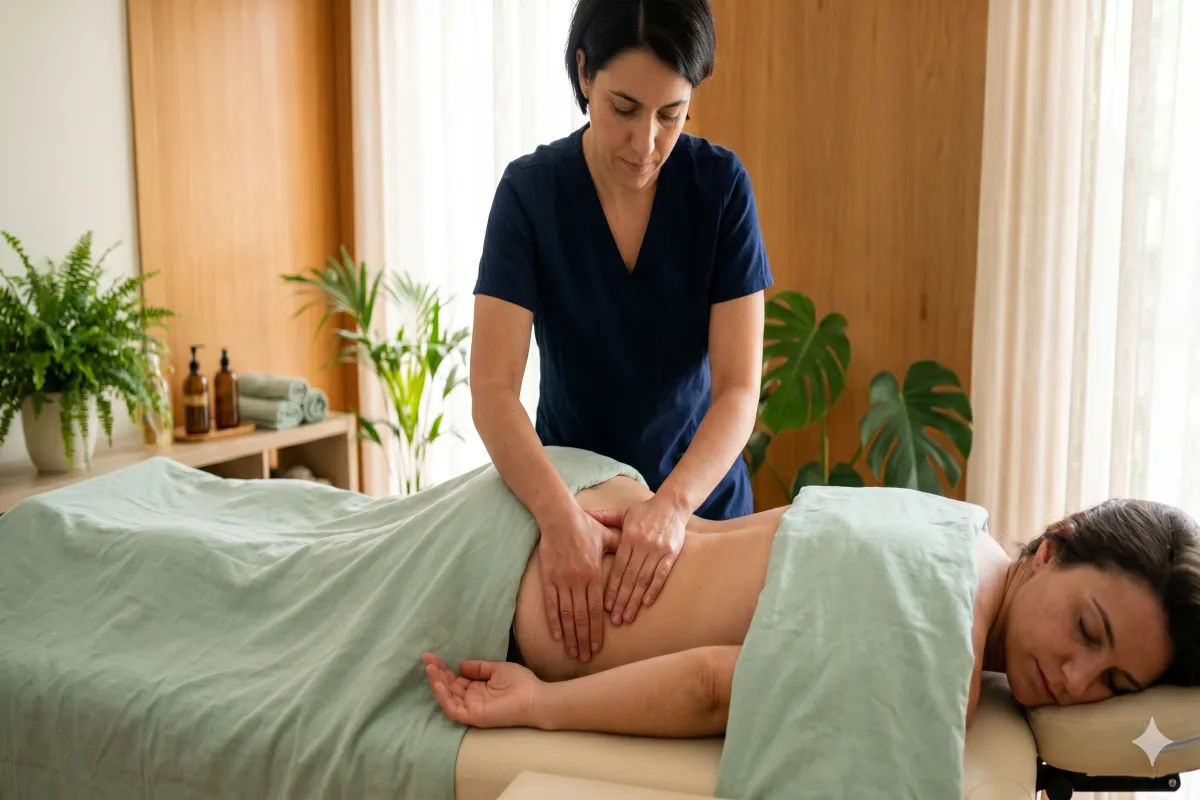
Pain that starts in the lower back region, descends through the buttock, radiates down the thigh, and can reach the foot. Sciatica is not just uncomfortable—it can be completely debilitating. And while medication helps control symptoms, therapeutic massage attacks the problem in a way pain relievers cannot: directly in the tissues that compress, inflame, and irritate the nerve.
What is sciatica and why does it hurt so much?
The sciatic nerve originates in the lower back spine (roots L4, L5, and S1), passes through the gluteal region, descends through the back of the thigh, passes the knee, and branches into the leg to the foot. It is the longest and largest nerve in the human body, which explains why its irritation can cause pain throughout this entire length.
The pathway is simple to visualize: the nerve originates at vertebrae L4–S1, passes beneath the piriformis muscle, descends along the back of the thigh, and branches into the leg. Any compression along this pathway can cause radiating pain, tingling, or numbness.
Sciatic pain (sciatica) is not a disease in itself—it is a symptom. The most common causes include lumbar disc herniation, spinal stenosis, piriformis syndrome, spondylolisthesis, and less frequently, tumors or infections. In Portugal, it is estimated to affect about 5% of the adult population at some point in life, with higher prevalence between ages 30 and 50.
How it manifests—typical symptoms
- Burning pain in the lower back
- Radiating through the buttock and thigh
- Tingling or numbness in the leg
- Weakness in the lower limb
- Pain that worsens with sitting
- Worsening with cough or sneeze
- Difficulty climbing stairs
- Unilateral pain (usually)
How massage works on the sciatic nerve
Unlike anti-inflammatories, which only suppress inflammatory response systemically, therapeutic massage intervenes directly in the tissues that surround and compress the nerve. The mechanisms are multiple and complementary:
Piriformis muscle relaxation
In many cases of sciatica, especially what is called piriformis syndrome, the piriformis muscle (located in the buttock, deep) is in spasm and compresses the sciatic nerve passing beneath it or, in 15–20% of the population, through it. Deep massage techniques and myofascial release in this area can free that compression significantly.
Reduction of tension in paraspinal muscles
Lower back paraspinal muscles under chronic tension contribute to narrowing the space between vertebrae, worsening nerve root compression. Work on these muscles reduces that pressure and improves spinal biomechanics.
Improved circulation and reduced inflammation
Massage stimulates local blood and lymphatic circulation, helping remove accumulated inflammatory mediators in tissues. In parallel, it promotes the release of endorphins, the body's natural pain relievers.
Nervous system modulation
Therapeutic touch activates the parasympathetic nervous system, reducing overactivity of the sympathetic system that frequently amplifies chronic pain perception. Clients with long-standing sciatica often feel this "turning off the alarm" effect during the session itself.
"After months of taking painkillers and unable to sit for more than 20 minutes, just four sessions were enough to get back to my normal life."
What the science says: A study published in the Journal of Traditional and Complementary Medicine (2015) showed that deep tissue massage was as effective as nonsteroidal anti-inflammatory drugs (NSAIDs) in relieving sciatic pain, with the advantage of having no gastrointestinal side effects.
The most effective techniques by phase
There is no single ideal technique for sciatica. At WellZen we combine various approaches depending on the phase of the process and characteristics of each client:
Lumbar effleurage (all phases) - Long, gentle movements along the lumbar paraspinal muscles. Warms tissues, improves circulation, and prepares for deeper work. Essential at the beginning and end of each session.
Piriformis release (subacute · chronic) - Sustained and progressive pressure on the piriformis muscle, in side-lying position. Releases spasms compressing the sciatic nerve. Often the technique that brings the greatest immediate relief.
Cross-friction (chronic) - Applied perpendicular to muscle fibers, it breaks down adhesions and scar tissue formed in chronic inflammatory processes. Temporarily uncomfortable, but very effective.
Myofascial release (subacute · chronic) - Works the fascia, the connective tissue surrounding muscles and nerves. Fascial restrictions can contribute significantly to nerve compression and are often overlooked.
Gentle manual traction (subacute) - Applied to the lower back and hip, creates temporary intervertebral space and relieves pressure on nerve roots. Requires specific training; should not be attempted at home.
Warm oil massage (all phases) - Deep heat relaxes spastic muscles and improves absorption of subsequent techniques. At WellZen we use blends of eucalyptus and ginger with documented anti-inflammatory properties.
Protocol by phase: acute, subacute, and chronic
Therapeutic approach varies substantially depending on the phase of the inflammatory process. At WellZen we always do an evaluation before each session to adjust the protocol:
Acute phase (0–72 hours)—calm and support
In the first 72 hours of a crisis, inflammation is at its peak. Deep massage is contraindicated; it can worsen the condition. In this phase, we work with very gentle effleurage to distal areas, relaxation and breathing techniques, and gentle mobilization to maintain circulation. The focus is reducing protective spasm without irritating inflamed tissues.
Subacute phase (3–21 days)—progressive work
Inflammation begins to subside and tissues are ready for more specific work. We introduce piriformis release, moderate pressure work on lumbar paraspinal muscles, myofascial release, and gentle joint mobilization. The ideal frequency is 2 sessions per week.
Chronic phase (more than 3 weeks)—pattern resolution
Chronic sciatica often involves established compensatory patterns, secondary muscle tension, postural changes, nerve sensitivity. Work here is deeper and more comprehensive: cross-friction, extensive myofascial release, hamstring and glute work, and neurodynamic techniques. One session per week is ideal for maintenance.
What you can do at home between sessions
Professional massage is most effective when complemented with home care. Here's what we recommend between sessions:
- Moist heat - Hot water bottle or warm moist towel on the lower back area for 15–20 min. Relaxes muscles and improves local circulation. Avoid cold in the first few weeks.
- Piriformis stretch - Lying on your back, cross the affected leg over the other and gently pull both legs toward your chest. Hold for 30 sec. Repeat 3×. Do this gently, without pain.
- Short walks - 10–15 minutes of gentle walking maintains mobility without overloading. Avoid remaining stationary or sitting for too long. Alternate positions regularly.
- Self-massage with ball - Place a tennis ball under the affected glute and apply gentle pressure on tension points. 60–90 seconds per point. Avoid if you feel radiating pain.
- Resting position - Sleep on your side with a pillow between your knees to reduce lower back tension. Avoid sleeping on your stomach; it increases pressure on nerve roots.
- Ginger oil - Dilute 4 drops of ginger essential oil in 10ml sweet almond oil and gently massage the lower back and gluteal area. Gingerol has proven anti-inflammatory properties.
Caution in acute phase: If pain is very intense or the phase is acute (less than 72 hours), avoid aggressive stretching and deep self-massage. When in doubt, consult your doctor or physiotherapist first.
When massage is not indicated
Therapeutic massage is safe in the vast majority of sciatica cases, but there are situations where it should be avoided or preceded by medical evaluation.
Seek urgent medical attention if you have: loss of bladder or bowel control, numbness in the perineal area ("saddle anesthesia"), progressive muscle weakness in the leg, or pain that started after trauma. These signs may indicate cauda equina syndrome, a neurological emergency.
Relative contraindications—consult your doctor first: sciatica secondary to tumor or infection, severe osteoporosis, oral anticoagulation, active deep vein thrombosis, or recent lower back surgery (less than 3 months).
At WellZen we always screen before the first session. Diana evaluates clinical history, phase of the process, symptom intensity, and existence of contraindications before starting any treatment.
Frequently Asked Questions
Can massage cure sciatica permanently? Massage does not resolve the structural cause of sciatica (like a herniated disc), but is extremely effective at reducing symptoms and improving quality of life. Combined with physiotherapy, proper exercise, and when necessary, medical intervention, it can lead to prolonged or permanent remissions, especially in functional cases (piriformis syndrome, chronic muscle tension).
How many sessions are needed to feel relief? Most clients feel measurable improvement between the 2nd and 4th session. In subacute cases, we recommend 2 sessions per week in the first 2–3 weeks, progressing to weekly sessions as symptoms improve. In chronic sciatica, the process may be more gradual but equally effective.
Can massage worsen sciatic pain? Deep massage poorly applied in an acute phase can temporarily worsen pain. That's why the choice of therapist and initial evaluation are so important. At WellZen we always adjust pressure and techniques to the phase of the process, never applying deep pressure to still-inflamed tissue.
Can I get massage if I have a confirmed herniated disc? Yes, in most cases. Massage does not act directly on the herniation, but works on muscle and fascial tissues that aggravate nerve compression. You should inform the therapist of the diagnosis and, ideally, share the imaging report. In herniation with significant neurological deficit, massage complements physiotherapy and medical support.
Is massage or physiotherapy better for sciatica? It's not a matter of choosing; they are complementary approaches. Physiotherapy focuses on therapeutic exercise, strengthening, and postural correction. Massage acts on soft tissues, releases tension, and reduces pain more immediately. Best results come from using both in parallel.
Can I get massage if I'm taking anti-inflammatories or muscle relaxants? Yes, generally there is no problematic interaction. Always inform the therapist of the medication you're taking. Muscle relaxants can make tissues more responsive to massage. Anti-inflammatories may mask some pain during the session, so we adjust pressure more carefully.